Fall 2022- Syllabus and Course Schedule

Psych. 310, Cognition

Professor - Erik Nilsen


Lecture: Tuesday, Thursday 1:50 - 3:20 p.m.

Human Computer Interaction Lab - BioPsy 121

Labs: BioPsy 121 Wed. 10:00 - 11:30 a.m. or 12:00 - 1:30 p.m.


Readings and texts to be announced in class and specified on syllabus.  Obtaining them is your responsibility.  One book required to purchase.

Thinking Fast and Slow by Daniel Kahneman.


Connection to Class Moodle Site for Assignments and Class Communication (Not live just yet!)


Course Overview
This course is designed to give you hands-on experience in scientific thinking, reasoning, and experimentation in the area of cognitive psychology. You will read about and participate in classic experiments in human cognition, critically evaluate these experiments, discuss their implications, as well as examine recent approaches (cognitive science, neural networks, evolutionary psychology) to cognition. In short, the course will allow you to directly work on and experience the types of tasks facing a modern-day research scientist in cognitive psychology.


Course Expectations and Assignments
This course will involve reading a great deal of primary source journal articles. It is expected that you will (thoughtfully) read the material before the class session.  I also expect active participation in all class discussion and activities.  Attendance is expected at all class sessions and is essential for all lab days.  These are days where the emphasis will be on experiential learning which cannot be made up for in other ways. If you have a known conflict with any of these dates, talk with me at least two weeks in advance and alternative arrangements (read more work ; ^ ) can be made.

Grading

35% Reaction Papers

Before specified class sessions in which we discuss an article, you are to read it and write some comments on the article. This can include a brief summary of the stated purpose of the article, how well the authors fulfilled that purpose, and what methods they used. You can also write any questions about concepts that were either unclear in the article or which need further elaboration. If you find any connection with other articles we have discussed in class or from your own experience, include these insights as well. Each paper should be less than 3 pages and take no more than one hour to write (above and beyond the reading time).  The papers will be used to inform class discussions, and some of them will undergo peer and/or instructor review.

35% Lab Reports

The lab section of this course is meant to provide hands on experience in cognitive psychology. Students will conduct experiments directly related to the principles learned in the lecture portion of the course. These experiments will be done online using a variety of sources from the internet including the CogLab 2.0 software. Students will also provide written reports (Using APA guidelines) of experimental findings collected throughout the semester.

15% Class Participation

Consistent contributions to in-class activities, class discussion, group work is expected. If you are not in class, you cannot participate! If you are here in body only, but have not prepared your mind, it may be duly noted!

15% Individual Research Project

For the final project you will be writing a complete APA empirical scientific paper. We will discuss a couple of options for completing this assignment.

Summary of Learning Objectives:

My overarching goals for Psy 310 are for you to acquire an understanding of the various theoretical perspectives, and research methods associated with cognitive psychology and to apply this understanding by formulating an individual research project. The learning objectives for this class include:

For the journal article and book discussions and laboratory exercises:

1. Explaining cognitive psychologists’ perspectives on the study of mental processes by:

2. Engaging in high-level discussion in response to scholarly readings by:

For the individual research project:

3. Demonstrating independence and intellectual maturity in the production of knowledge by:


Fall 2022 Office Hours - 11:30 - 12:30 T, TH. BioPsy 120. Zoom consultation by appointment Wed 2:30 - 3:30 p.m. email nilsen@lclark.edu.


Day & Date

Topic 

T Aug. 30

Introduction - Memory and Name Games!

Peruse the World Memory Championship Website. Here is a list of a huge number of Memory World Records.

Lab #1 Mnemonic Techniques

Presidents and Name Mnemonics, Coglab 2.0 Exp. Link Word

Lab Write up is found on the class moodle site. It is due (submit on the moodle by Lab class time, Wednesday, Sept. 8th

Animaniacs teach the US presidents with music and mnemonic.

Another spicy way to memorize the presidents with a country vibe with a music video by Jonathon Coulton.

Sporcle is a fun website that has some activities that may help you learn the president's names.

Mnemosyne is a FREE software package that helps you memorize lists of material by optimizing the spacing of rehearsal for Lists of your creation. Use it for the President Lab if you like!


Read this article before class and be ready to discuss this case study and it's implications for using this strategy for learning foreign vocabulary. What strategies have you used to learn a foreign language or other academic material?


W Aug. 31 LAB

No class meeting today. work on Lab #1 Mnemonic Techniques Due on the class moodle on Wednesday, Sept. 7th.

Presidents (or Unforgettable 44) and Name Mnemonics (Using Yo Millard Fillmore book provided by Erik), Coglab 2.0 Exp. Link Word

Short interview introducing the Unforgettable (Fierce) 44 book. Whoopi Goldberg approved!

 
Th Sep. 1

Morris (2005) Strategies for Learning Proper Names: Expanding Retrieval Practice, Meaning and Imagery.

REACTION PAPER (submit on the moodle before class time today)

This paper presents us with 3 experiments - In layman's terms, describe the name memorization techniques used in these studies. How do they differ in their operational definitions across the experiments. Briefly describe the reasons behind conducting the 2nd and 3rd experiments, why didn't they just stop at 1! Finally, if you were going to tell your mother the best method to help her memorize the names of people on her upcoming National Convention of ????? what would you recommend that she do based on this study?

Beaton et. al. (2005) Facilitation of receptive and productive foreign vocabulary learning using the keyword method: The role of image quality.

Linkword Languagescommercial site derived from research on mnemonics and language learning.

Advance preparation notes (Be ready to work in small group breakout rooms to develop the list [with examples] described below.

Read the Beaton (2005) paper and pay special attention to Appendix 1. what features do you find that distinguish between the "good keyword" versus the "poor keyword" images? Try to come up with a short (5 - 9) list of differences along with recommendations about how to generate effective keyword images. after doing this, check out two languages of the free online demo's at the Linkword Languages website (notice who designed these courses!). Comment on the quality of the keyword images of the demo's using your criteria derived from the research paper (with several illustrative examples). Does Gruneberg practice what he preaches? A brand new updated slick web site for Gruneberg's company can be found at http://www.unforgettablelanguages.com/

T Sep. 6


Moe (2005) Stressing the Efficacy of the Loci Method: Oral Presentation and the Subject-generation of the Loci Pathway with Expository Passages

Kondo (2004) Changes in brain activation associated with use of a memory strategy: a functional MRI study.


Lab Writeup (submit this one on the moodle by 5 p.m. Wednesday Sept. 14th.)

  1. For readings - Moe (2005) & Kondo (2004) Focused Question, submit before class.

(1) Ok, so these 2 papers study the mnemonic technique called "The Method of Loci" using very different methodologies. Compare and contrast the research methodology of the papers and what new information they give about the mechanisms underlying the most successful use of this mnemonic device.


(2) Use the Terminology of the Moe Paper to describe the task used and the 2 recall conditions in Kondo (2004). Incorporate the concepts of Oral vs written modality, rehearsal vs. method of loci, experimenter vs subject-generated pathways, expository vs. descriptive vs. narrative passages. Did Kondo use the "optimal" combination of stimuli and task characteristics in their study?


(3)Take the plunge and suggest a thought experiment that combines ideas from both papers to really highlight the differences in brain activation using fMRI recording of people doing Rehearsal vs. Method of Loci Memorization. What results would you expect?


W Sep. 7 LAB

We will start off class by showing off our prodigious Memorization Skills of Presidents and the Unforgettable 44!

Alpha and Omega of Memory Research

Maguire (2002) Routes to remembering: the brains behind superior memory

Autistic man is a "Living Camera"

Simon Reinhard setting world record for memorizing card deck (with awesome soundtrack)! Alez Mullen, memory athlete, explains how it is done! (view first 4 minutes)

Einstein's Brain Glial Cells Rock!

Real Rain Man Kim Peak

Brain Man Daniel Tammet learns Icelandic in a week!

Th Sep. 8


Read Chapters 1 - 3 of Hermann Ebbinghaus' landmark Dissertation on Memory.

Hermann Ebbinghaus (1885) Über das Gedechtnis: Untersuchungen zur experimentellen Psychologie. English Translation (Memory: A Contribution to Experimental Psychology)

REACTION PAPER (submit rough draft on moodle by class time today and final version by 5 p.m. Friday Sept 10th)

For chapters 1 - 3, your reaction paper should highlight how he defined memory and it's measurement. Also describe in a few paragraphs what experimental procedures and operational definitions he used to make the study of memory possible from an empirical, scientific standpoint.


T Sep. 13


Read the articles and be ready to discuss them with special attention to the ART theory. Reaction paper to come after you get your Walk On! Stay tuned.

Get Your Walk On! Cognitive Benefits of Walking in Nature and more!

Berman, M. G., Jonides, J., & Kaplan, S. (2008). The cognitive benefits of interacting with nature. Psychological science, 19(12), 1207-1212.

Berman, M. G., Kross, E., Krpan, K. M., Askren, M. K., Burson, A., Deldin, P. J., ... & Jonides, J. (2012). Interacting with nature improves cognition and affect for individuals with depressionJournal of affective disorders140(3), 300-305.

Hunter, M. R., Gillespie, B. W., & Chen, S. Y. P. (2019). Urban nature experiences reduce stress in the context of daily life based on salivary biomarkers. Frontiers in psychology10, 722.

Silvia, P. J., Fayn, K., Nusbaum, E. C., & Beaty, R. E. Openness to Experience and Awe in Response to Nature and Music: Personality and Profound Aesthetic Experiences.

This is an "Awesome" article that even references an LC Psych. prof! See if you can find out who it is!


W Sep. 14 LAB

Today we are literally going to take a walk in the park (weather willing) living out the promise of ART theory we discussed in class yesterday! Wear good walking shoes, bring your water bottle and favorite music to walk to if you are so inclined!

I'm just gonna leave this here to help you get your groove on and celebrate September with Earth, Wind & Fire!

I had this single on a vinyl 45 back in 1978 when I was 16!

and here is the video of Earth, Wind & Fire being honored at the 2019 Kennedy Center Show for their contributions to American Culture and Multiple Musical Genres

Post Nature Walk Reflection Paper (Due Tues. Sept. 20th by class time).Assignment 


Th Sep. 15

Group Assignments for Ebbinghaus Presentation

For Chapters 5 - 9, the following groups will prepare a ten - twelve minute presentation for the rest of the class. Have everyone in the group participate in the presentation

(1) What new phenomena is studied in this chapter and what new concepts are defined

(2) choose 1 table of figures and write an explanation of what it reveals

(3) general conclusions and/or "laws" of memory does Ebbinghaus derive from this chapter?

(4) find at least one example of more recent research that has built on Ebbinghaus' contribution in this area.


Chapter 5. Rapidity of Learning Series of Syllables as a Function of Their Length 


Chapter 6. Retention as a Function of the Number of Repetitions


Chapter 7. Retention and Obliviscence as a Function of the Time


Chapter 8. Retention as a Function of Repeated Learning

 A

Chapter 9. Retention as a Function of the Order of Succession of the Members of the Series

A


No Reaction Paper Due, your group presentation will be the basis for evaluation for today.


T Sep. 20

Hunt (1995) The subtlety of distinctiveness: What von Restorff really did

Kishiyama (2004) The von Restorff Effect in Amnesia: The Contribution of the Hippocampal System to Novelty-Related Memory Enhancements

Discussion topics to consider while reading - compare and contrast the methodologies and conclusions. Try to come up with 3 different examples of how the memorial distinctiveness that vonRestorff elucidated has real life practical application.


Amping Up Our Memory - Cognitive Enhancers and Nootropics are onr the bleeding edge of science and pseudoscience.

Here is a shortish overview article on Types of Cognitive Enhancers that are available today.

Savulich, George, et al. "Focusing the neuroscience and societal implications of cognitive enhancers." Clinical Pharmacology & Therapeutics 101.2 (2017): 170-172.


Here is another short article with a bit of overlap and a different perspective.

Augmented memory: a survey of the approaches to remembering more.

Christopher R. Madan* Department of Psychology, University of Alberta, Edmonton, AB, Canada Front. Syst. Neurosci., 03 March 2014 | doi: 10.3389/fnsys.2014.00030


Brain Zapping to Boost your smarts!! Science and/or Scam

News Report that Electrical Brain Stimulation may enhance memory! Original Article from Science August 2014!

Reinhart, R. M., & Nguyen, J. A. (2019). Working memory revived in older adults by synchronizing rhythmic brain circuits. Nature neuroscience22(5), 820-827.


W Sep. 21

LAB

Lab #2 Serial Memory Lab

Coglab 2.0 Experiments - von Restorff Effect.

Lab write up is found on the class moodle site. It is due (submit on the moodle by class time, Wednesday, Sept. 28th


Th Sep. 22

Facial Emotion - Truth and Deception

Read these 2 articles before class and be prepared to discuss. You will find them on the class google drive. (No reaction paper this time).

Ekman (2003) Darwin, Deception, and Facial Expression

Blow(2006) Perception of Robot Smiles and Dimensions for Human-Robot Interaction Design.

These are links we will look at during class today!

Smile Experiment (do not access before class)

Psychology Today article on the science of smiling (Proceed with caution)

Paul Ekman's F.A.C.E web page including a demo of METT

Ron Gutman's Ted Talk on the Power of Smiles!

Kaspar Robot used to help Autistic kids learn to recognize facial expressions of emotion.

Here is a Robotic Head that is firmly in the Uncanny Valley IMHO!

And a pair of Japanese Robots whose creators say have crossed to the other side of the Uncanny Valley?! You decide!


T Sep. 27

Baddeley 1994 The Magical number seven: Still magic after all these years? I suggest you read this one first.

Read the classic paper by George Miller entitled: The Magical Number Seven, Plus or Minus Two: Some Limits on Our Capacity for Processing Information. This paper, written in 1956, helped launch the information processing paradigm in psychology and his 7+/- 2 chunks in STM is certainly the most widely cited "number" in memory research. I am asking you to read the original. This is very dense reading. To help us understand it better I am assigning each of you one of the sections to summarize (in writing) and present orally in class in small group breakout rooms. Be sure to define any terms that need it and to explain any graphs that are in your section. You may need to do a bit of outside research to fully understand the material, try to put it into your own words. You will have 15ish minutes at the beginning of class to ask Erik questions and discuss the material with peers who also wrote on your section before presenting it (individually) in small group breakout rooms. The section assignments are given on the class moodle and below.

Tues., Sept 28th - Miller's Magical Number Writeup due at class time today.


Information measurement (Erik)
 
Absolute judgments of unidimensional stimuli (Group 1)


Absolute judgments of multidimensional stimuli (Group 2)


Subitizing (Group 3)


The span of immediate memory (Group 4)


Recoding (Group 5)


W Sep. 28 LAB

Read CogLabWorkingMemoryLab3.pdf in preparation for a discussion of today's lab.

Ted Talk on Working Memory

Good News Neuroracer Research to Train Working Memory in older folks using Dual Task Video Game

Bad News Your Smartphone Reduces Your Brainpower, Even If It’s Just Sitting There. Magazine Article | Original Research Paper


Lab #3 Working Memory Capacity

Coglab 2.0 Experiments - Memory Span, Operation Span

Lab write up assignment is found on the class moodle site. It is due (submitted on the moodle by class time Wed. Oct. 5th)


Th Sep. 29


Introduction to Mind Mapping Concept and Software to support it. Spend time trying out these tools.

After class today you will know how to create a Mind Map of Characteristics, Principles of Operation and Relationships between "System 1" and System 2" set up in Chapter 1 and fleshed out in chapters 2 - 4. You can do this on paper or using any online tools you choose. Upload your mind map to the Class moodle assignment due Tuesday, Oct. 4th by class time. Also bring a printout of your mind map to discuss with a classmate.

WikiPedia Page entry on Mind Mapping.


Several online Mapping Software tools are discussed and linked at 

http://lifehacker.com/five-best-mind-mapping-tools-476534555

here are a few links to online mind mapping tools

X-Mind

Mind Meister


Bubbl.us


T Oct. 4

Thinking Fast and Slow - Read Introduction through Chapter 4 (to pg. 58)

We will discuss the first chapters of Thinking Fast and Slow, watch a video or 2 and go over our mind maps in small groups. Come ready to share your mind map using the share screen feature of google.


W Oct. 5 LAB

No LAB meeting today!


A pause that refreshes, start your fall break a bit early if you like, but take Thinking Fast and Slow along with you to prepare for Next Tuesday's presentations!


TH Oct. 6


Fall Break - No class today.


T Oct. 11

Thinking Fast and Slow - Class discussion and individual presentations

Read Chapters 5 - 9. Research presentations assigned below. The first person in each group is the main presenter, the others are respondents. The page numbers in Parens refers to the page in Thinking Fast and Slow that the research is mentioned.

Thinking Fast and Slow Assignments Presenter Respondents
   
Chapter 5 - 9
Jacoby(1989,p60-61) Annika   Sam Taylor Sophia W Jonah Emi
Zajonc(1968, p 66-67) Gabby   Sanaa Cari Claire Lindsay  
Leslie(1987,p76) Sage Issa Jovo Marzieh Kayla  
Gilbert(1990,p80-81) Michael Roxanne Julia Jayme Tasha  
Strack (1988, p101) Sophia P Emma G. Emma R. Rusty Elijah  


W Oct. 12 LAB

TBD

Th Oct. 13

Thinking Fast and Slow - Class discussion and individual presentations

Read Chapters 10 - 14. Research presentations assigned below

Thinking Fast and Slow Assignments Presenter Respondents
   
Chapter 10 - 14
Brenner(1996, p86) Jayme   Sam Sophia P Cari Roxanne Emma G
Todorov(2005,p90-91) Sanaa   Taylor Michael Claire Julia  
Gilovich(1995,116-117) Jovo   Sophia W. Sage Lindsay Tasha  
LeBoeuf(2006,p121) Emma R.   Jonah Gabby Issa Elijah  
Mussweiler(2000, 123) Marzieh   Emi Annika Kayla Rusty  
T Oct. 18


Thinking Fast and Slow - Class discussion and individual presentations

Read Chapters 15 - 23. Research presentations assigned below

Thinking Fast and Slow Assignments Presenter Respondents
   
Chapter 15 - 23
Schwarz(1991,131-132) Sam   Kayla Lindsay Claire    
               
Hsee(1998,160-161) Cari Jovo Sanaa Sage Emma R  
Meehl(1986,222-223) Jonah Sophia W Emi Michael    
Dawes(1979, p226) Julia Gabby Issa Annika    
Kahneman(2009, 234-237) Elijah Tasha Rusty Marzieh    


W Oct. 19 LAB

A brief mental palate cleanser from Thinking Fast and Slow!

Exploring the Somatic Marker Hypothesis

Cognitive Neuroscientists use case studies, neural network modeling and laboratory-based gambling tasks to understand the role of emotion and cognition in risky decision-making. In this section we will be exploring this topic with the material below.

Before you read the material below, go to this website and fill out the personality inventory and play the Iowa Gambling Card Game that follows. This is the experimental task that is used to test the Somatic Marker Hypothesis in the research papers we will be reading. Doing this game in advance will help you understand the articles better and you will not be biased by knowing about the task before taking it. Take a screen shot of your results if you can to compare your results with the results in Bechara (1997) for the control group.

Next read the Wikipedia Page for the Somatic Marker Hypothesis!

Finally read through the two articles below. Erik e-mailed them to you and you can find them on the google drive class resources page.

The first article below is the first empirical study presenting laboratory evidence for the Somatic Marker Hypothesis (SMH). The followup article present a critique on how Bechara et al. interpreted their results and an alternative view about the relationship between cogniton and emotion in the Iowa Gambling Task! Be ready to engage in argument and debate over this heated topic, GSR's will raise! Which article do you find most persuasive? We will vote on it in class!

Bechara (1997) Deciding Advantageously Before Knowing the Advantageous Strategy.

Maia (2004) A reexamination of the evidence for the somatic marker hypothesis: What participants really know in the Iowa gambling task


Th Oct. 20


Thinking Fast and Slow - Class discussion and individual presentations

Read Chapters 24 - 28. Research presentations as assigned below

Thinking Fast and Slow Assignments Presenter Respondents
   
Chapter 24 - 28
Slovic(1999,139-140) Taylor   Sophia P Jayme Roxanne Emma G    
Kahneman(1990, p296) Sophia W.   Taylor Sam Sophia P Jayme Issa  
Novemsky(2005, p284-285) Emi   Cari Emma R Jovo Sanaa    
Åstebro(2006, p257) Lindsay Jonah Marzieh Claire Kayla    
Berner(2008, p263) Tasha Julia Michael Gabby Annika    
Kermer(2006, p293) Rusty Elijah Sage Emma G Roxanne    


T Oct. 25

Thinking Fast and Slow - Class discussion

Read Chapters 29 - 34. Research presentations as assigned below

Thinking Fast and Slow Assignments Presenter Respondents
   
Chapter 29 - 34
               
Bertrand(2006, 298) Claire Taylor Sam Sophia P Jayme Lindsay  
Kahneman(1986, p306) Kayla Cari Emma R Jovo Sanaa    
Viscusi(1987, 316) Emma G Jonah Marzieh Sophia W Emi    
Yamagishi(1997,329-330) Roxanne Julia Michael Gabby Annika    
Quiodbach(2010)p397 Issa Elijah Sage Tasha Rusty    
W Oct. 26LAB

Discussion and workshop for Final Project Proposals

Upload a 1 - 2 page document containing the basic idea of your research project, including methodology, hypotheses and citation and brief summaries of at least 2 primary source research articles related to your topic. Post this information to the class moodle page by Wed. Nov. 3rd and followup with a consultation with Erik during lab office hours!


Th Oct. 27

Thinking Fast and Slow Read Part V - Two Selves Chapters 35 - 38. We will be discussing the whole section and its real life implications as a class. Here is a word cloud with relevant concepts.
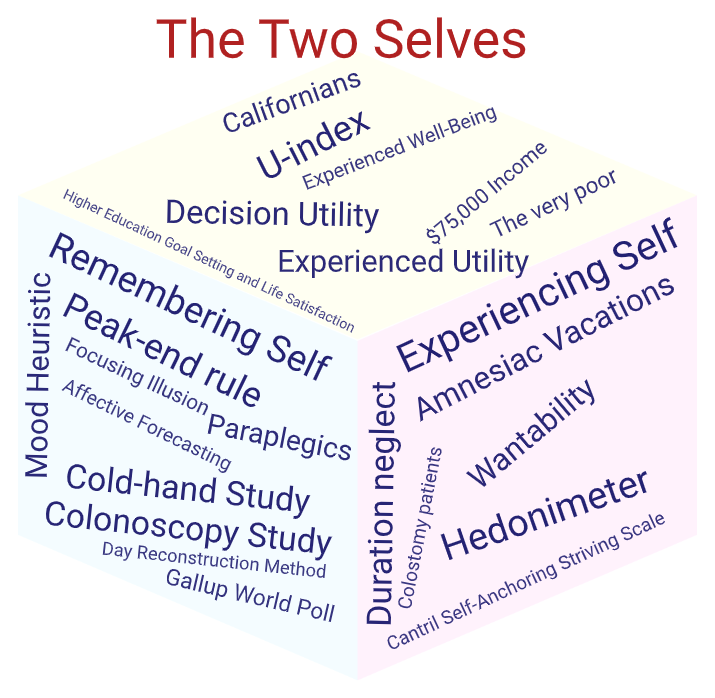
Two Selves Word Cloud from Thinking Fast and Slow Book

Moodle Assignment will be to either write a reaction paper or create a mind map comparing and contrasting the research and lived examples of the Experiencing versus Remembering Self that Kahneman presents in this final section of the book.


We will also be reprising the whole Magnus Opus today and assigning small groups to discuss in zoom rooms and present to the class ways that TFS informs our understanding of a few minor topics like

1) COVID Testing, Mitigation Strategies and Vaccination Messaging

2) Global Climate Change

3) Systemic Racism

4) Immigration Policy

5) Health Care Policy

6) Gun Control Policy


T Nov. 1


Consultations with Erik to refine and advance Final Project Proposals! Each person signs up for at least 1 meeting after submitting their Initial Proposals on the class moodle page.


W Nov. 2 LAB


Consultations with Erik to refine and advance Final Project Proposals! Each person signs up for at least 1 meeting after submitting their Initial Proposals on the class moodle page.


TH Nov. 3


Psychology of Humor

Please (1) Read the links provided below, (2) watch the videos, (3) take the Humor Styles Questionnaire, and (4) contribute to the class moodle forum by the end of the day on Saturday.  

I want each of us to come up with one question or open ended observation from the course material assigned for today and post it on this forum as a new item by the end of the day on Saturday, Nov. 6th.

By class time on Tuesday, Nov. 9th, each person should respond to at least 3 of the initial postings with your own perspective or answer to the question posed.

(*Make sure that your postings show that you read and engaged with the material and can be answered in a open ended way rather than just a simple YES or NO!*). I will seed the forum with an entry or 2 to give you examples. You can respond to 1 of mine if you choose as part of the 3 assigned responses.


What's so funny, and why, and where?

The Science of Humor Video. Accompanying Overview Paper. What Makes Things Humorous.

Humor comprehension in older adults. Mak(2007).pdf

Humor Modulates the Mesolimbic Reward Centers. Mobbs(2003).pdf

Here is the Humor Styles Questionnaire to take online and a short introduction to the measure and the theory behind it.

Martin, R. A., Puhlik-Doris, P., Larsen, G., Gray, J., & Weir, K. (2003). Individual differences in uses of humor and their relation to psychological well-being: Development of the Humor Styles Questionnaire.Journal of Research in Personality37, 48-75.

The Laugh Lab of Dr. Richard Wiseman. Cross Cultural Appreciation of Humor. The original Laugh Lab Final Report from 2002. and a list of 1001 clean jokes from the study!

Gotta Love the Far Side Humor! An animated short.

Laughter Online University Website.


T Nov. 8

False Memories - In the Lab and Beyond!!


Watson (2004). Attempting to avoid false memories in the Deese/Roediger–McDermott paradigm: Assessing the combined influence of practice and warnings in young and old adults.

Wade (2002). A picture is worth a thousand lies: Using false photographs to create false childhood memories.

Greenberg (2004). President Bush’s False ‘Flashbulb’ Memory of 9/11/01.

False beliefs about fattening foods can have healthy consequences. Alda/Loftus video clip (33:08 - 40:12)


W Nov. 9 LAB

False Memory Lab

We will go over and set up the lab in class. You will run participants using Coglab sometime before Tuesday, Nov. 15th and turn in the lab report on that day.


Th Nov. 10

Slips of the tongue and action: A Theory of Attention Based on Errors!


We will be looking at the cognitive psychology of slips of the tongue (aka Spoonerism) and slips of action.  We all succumb to these odd mistakes that catch us by surprise.  Have you ever ended up in your driveway when you intended to drive somewhere else?  Have you ever been in the shower and forgotten if you shampooed yet?  You know that I have said things that I did not quite intend a number of times in class this term and if you admit it, you do this occasionally as well!  I have two articles with amusing collections of these types of errors and a model of attention that tries to explain them! 

Norman, D. A. (1981). Categorization of action slips. Psychological review88(1), 1. (Find it on the Class Google Drive)

Hauptman, Don (2014) ""Pay No Attention To The Can Behind The Merton" A Gallimaufry of New Spoonerisms," Word Ways: Vol. 47 : Iss. 3 , Article 2. 
Available at: https://digitalcommons.butler.edu/wordways/vol47/iss3/2

T Nov. 15

Sex and Gender and Psychology, OH MY!


The Future of Sex and Gender in Psychology: Five Challenges to the Gender Binary is a thoughtful piece that will give us a lot to think about.

We will form small working groups to lead discussions of the 5 sections of the paper below.


The Challenge From Neuroscience

The Challenge From Behavioral Neuroendocrinology

The Challenge From Psychological Research: Gender Differences and Similarities

The Challenge From Psychological Research With Transgender and Nonbinary Individuals

The Challenge From Developmental Psychology


Changes Over Time in the Comprehension of He and They as Epicene Pronouns is an article that shows that personal pronouns matter in how they prime our reading and how the language has changed over 15 years.


Finally, Introducing a gender-neutral pronoun in a natural gender language: the influence of time on attitudes and behavior is an article that I found that is a case study of how Sweden was the first (and so far only) country to add a third gender-neutral pronoun to their language and how public perception transformed over a 4 year period.

A very interesting article that shows how other languages beyond Swedish are adjusting to a multigendered world!


W Nov. 16 LAB

SPSS and APA Figure Creation Workshop using False Memory dat collected last week.


Th Nov. 17

Music and the Mind!!


For Tuesday please read and be ready to discuss (and perhaps vocalize?!?!)

I have 4 articles I want us to discuss about different research approaches that that illustrate the powerful role music can impact our cognition and wellbeing on many levels.


Vickhoff, B., Malmgren, H., Åström, R., Nyberg, G., Engvall, M., Snygg, J., ... & Jörnsten, R. (2013). Music structure determines heart rate variability of singersFrontiers in psychology4, 334.

     This paper aims to illuminate how singing and especially choir singing promotes wellbeing.


Tsang, C. D., Falk, S., & Hessel, A. (2017). Infants Prefer Infant-Directed Song Over SpeechChild development88(4), 1207-1215.

In their everyday communication, parents do not only speak but also sing with their infants. However, it remains unclear whether infants’ can discriminate speech from song or prefer one over the other. The present study examined the ability of 6- to 10-month-old infants (N = 66) from English-speaking households in London, Ontario, Canada to discriminate between auditory stimuli of native Russian-speaking and native English-speaking mothers speaking or singing to their infants. Infants listened significantly longer to the sung stimuli compared to the spoken stimuli. This is the first study to demonstrate that, even in the absence of other multimodal cues, infant listeners are able to discriminate between sung and spoken stimuli, and furthermore, prefer to listen to sung stimuli over spoken stimuli.


Satoh, M., Yuba, T., Tabei, K. I., Okubo, Y., Kida, H., Sakuma, H., & Tomimoto, H. (2015). Music therapy using singing training improves psychomotor speed in patients with Alzheimer's disease: a neuropsychological and fMRI study. Dementia and geriatric cognitive disorders extra5(3), 296-308.
Music therapy intervention using singing training may be useful for dementia patients by improving the neural efficacy of cognitive processing. 
Schneider, C. E., Hunter, E. G., & Bardach, S. H. (2018). Potential Cognitive Benefits From Playing Music Among Cognitively Intact Older Adults: A Scoping Review. Journal of Applied Gerontology, 0733464817751198.
The purpose of this study was to review the current evidence related to playing a musical instrument being a potentially protective mechanism against cognitive decline among older adults. 11 studies all showed that music playing was correlated with positive outcomes on cognitive ability; more high-quality research is needed in this area to understand mechanisms behind potential cognitive protection of music.

T Nov. 22


Meditation and the Brain

Neural correlates of attentional expertise in long-term meditation practitioners. Brefczynski(2007).pdf

Short-term meditation training improves attention and self-regulation Tang(2007).pdf

Loving-Kindness Meditation Increases Social Connectedness Hutcherson(2008).pdf

Buddha’s Brain: Neuroplasticity and Meditation Davidson(2007).pdf


Way out there. The god helmet! and brain damage induced religious experience


W Nov. 23 LAB

Happy Turkey (or Tofu) travel day!

Final Project - Draft of Introduction, Lit Review and Methodology due at 5 p.m. Today


TH Nov. 24

Happy Turkey (or Tofu) day!

T Nov. 29

Introduction to Sensory-Sensory, Sensory-Motor Interactions, Illusions and Delusions!

Good six minute Overview Video of Synesthesia with Witthorft Shoutout!

Hearing Colors, Tasting Shapes. RamaHubbardSciAm_2003.pdf. Vilayanur S. Ramachandran and Edward M. Hubbard. Scientific American. p 52 - 59. May, 2003.

SYNESTHETIC COLORS DETERMINED BY HAVING COLORED REFRIGERATOR MAGNETS IN CHILDHOOD Witthorft(2006).pdf

Synesthesia Overview and Case Studies

Synesthesia Immersion Video - Colorful Acoustic Letters!

Musical Color 360 Immersive video

Rama - Lama- chandran NOVA video on Secrets of the Mind on Phantom Limb Syndrome will be shown in class. Be prepared to be intrigued!

Phantom Limb Therapy

A controlled pilot study of the utility of mirror visual feedback in the treatment of complex regional pain syndrome (type 1). McCabe(2003).pdf

Investigating the efficacy of a virtual mirror box in treating phantom limb pain in a sample of chronic sufferers. Murray(2006).pdf


W Nov. 30. LAB


Phantom Fun, Somatosensory Strangeness, and Kinesthetic Quirks.

Touching a Rubber Hand: Feeling of Body Ownership Is Associated with Activity in Multisensory Brain Areas. Ehrsson(2005).pdf

Rubber Hand Video (don't watch until class time)

First Person Experience of Body Transfer in Virtual Reality

Phantom Sensory Remapping

VR for Phantom Pain Relief


Th Dec. 1

Human Cognition Through the Lens of Social Engineering Cyberattacks

Bhusal, C. S. (2021). Systematic Review on Social Engineering: Hacking by Manipulating Humans. Journal of Information Security12, 104-114.

Montañez, R., Golob, E., & Xu, S. (2020). Human cognition through the lens of social engineering cyberattacksFrontiers in Psychology11, 1755.

T Dec. 6


1st draft of Results and Discussion Section due on class moodle page Due at class time today.

We will be conducting a prof. directed peer review during class today

W Dec. 7 LAB


Workshop to Create Data sets for Final Project

Monday Dec. 12th

8:30 - 11:30

Erik will be available in the classroom for consultation on your final paper. Signup will be provided.

Final Papers are due in electronic form, uploaded to the moodle by 11:59:59 p.m. on the evening of Wednesday, Dec 14th.


http://webhost.lclark.edu/nilsen/310fa22.html


Created by nilsen@lclark.edu